The culprit is a mountain of disconnected spreadsheets, email chains, and one-off apps. FMI’s “Construction Disconnected” report found professionals lose 14 hours every week—35 percent of their time—just hunting for information or fixing preventable mistakes.
Owners are pushing back. More than half of U.S. project owners now insist on a single connected platform that moves data cleanly from design through turnover. That demand reshapes the software field and leaves you with two paths:
- Adopt an all-in-one suite that offers one login and one source of truth.
- Stitch together best-of-breed point tools and trust the APIs to keep everything talking.
We spent the last quarter reading analyst briefs, skimming Reddit threads, and testing trial accounts to surface ten platforms that help teams deliver work on time and on budget.
Here’s what you’ll get in the next few minutes:
- An evidence-based scoring system behind our rankings.
- Insight into 2026 tech trends—AI scheduling, digital twins, and more—and how they shape your buying decision.
- Narrative reviews of each top solution, written for GCs, specialty contractors, and owners.
Let’s dig in and find the tool—or combination of tools—that finally connects your field crews, office staff, and partners without the costly gaps holding projects back today.
Why connected construction software is crucial
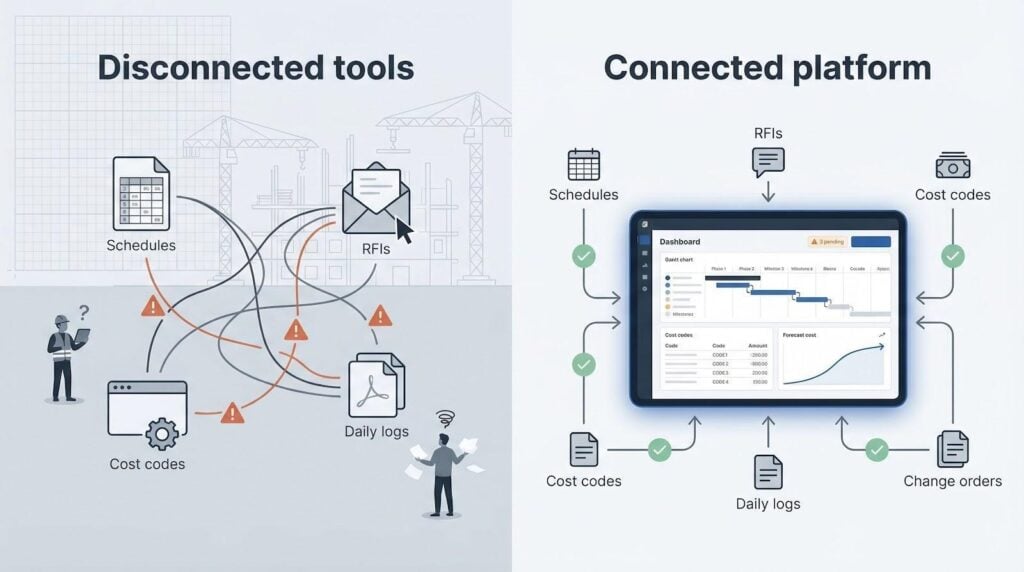
Let’s zoom in on the root problem crews face on site and in the trailer: information chaos.
When schedules, RFIs, and cost codes sit in half a dozen apps plus spreadsheets, data slips through the cracks. The FMI study cited earlier puts a hard number on the waste: 14 hours each week are lost to file hunts or fixing avoidable mistakes. That is a full workday gone before the crew even pours concrete.
The gaps grow expensive fast. Large projects already run 20 percent longer and up to 80 percent over budget, according to McKinsey’s global review. Every missing drawing revision chips away at margin and erodes client trust.
Owners recognize the problem. In 2022, more than half adopted a single connected platform to keep design, field, and finance moving in lockstep. When the client demands real-time transparency, a patchwork stack is no longer defensible.
Integrated software changes the story. One schedule update alerts subs, syncs mobile punch-list deadlines, and realigns forecast cost curves in minutes. The field never wonders which drawing is current; the platform displays the latest set by default. Accounting pulls approved change orders straight from the same record the superintendent closes on her tablet.
InEight’s Control module ties those field quantities directly to cost codes and its earned-value engine.
Product documentation notes that this real-time visibility has helped contractors catch overruns early enough to save up to 10 percent in software and technology spend, turning routine data syncs into bottom-line protection.
That flow saves dollars and goodwill. Questions stay inside the tool, so blame games fade. Younger project managers, digital natives, embrace the shift, while seasoned supers find they can file a daily log from their phone before leaving the jobsite.
Are point tools still useful? Absolutely. A focused app like Bluebeam or Fieldwire shines at specific tasks. The catch is integration friction. If an estimate never moves cleanly into the project budget, you re-type numbers and invite risk.
So the real choice is not “suite or nothing.” It is deciding how many links in your data chain you can tolerate before the weakest one snaps. In the next sections, we’ll explain exactly how we scored the leading platforms on breadth, ease of use, integration strength, and value, so you can pick the setup that keeps every stakeholder reading from the same playbook.
How we evaluated the platforms
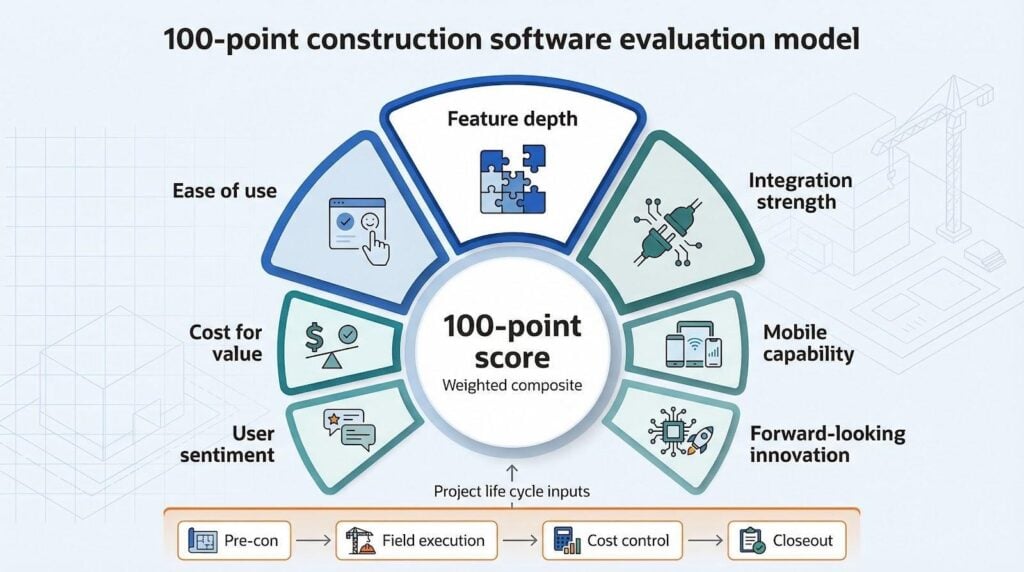
You deserve a ranking based on evidence, not gut feel or affiliate payouts, so we built a scoring model and followed it.
First, we mapped the entire project life cycle (pre-con, field execution, cost control, closeout) and listed the software capabilities that truly move the needle at each stage. From there, every candidate earned points across seven buckets.
Feature depth carried the most weight. A platform had to manage drawings, RFIs, schedule changes, cost events, and mobile field input without forcing work-arounds. If a tool excelled in one area but ignored the rest, its score reflected the gap.
Ease of use came next. We watched foremen and project engineers explore trial accounts, timing how long it took them to create a daily log or upload a revised plan. Confusing menus shaved points, while smooth onboarding added them.
Integration strength mattered just as much. We rewarded open APIs, out-of-the-box QuickBooks or Sage links, and marketplaces with proven add-ons. Closed gardens lost ground because duplicate data entry drains profit.
Cost for value stood in its own column. We compared sticker prices, hidden training fees, and break-even stories in customer case studies. A high price tag is acceptable when time savings or risk reductions are clear and documented.
User sentiment was not hearsay. We scraped the latest Capterra and G2 reviews, tossed out noise, and focused on consistent praise or pain. Those scores rolled into our model after normalization.
Mobile capability and forward-looking innovation rounded out the list. A platform without reliable offline sync or a plan for AI scheduling cannot call itself future ready.
The result is a weighted composite on a 100-point scale with transparent notes for every deduction or bonus. That score sets the order you will see in the next section, with no vendor influence, no editorial shortcuts, and proof you can audit.
2026 tech trends shaping your shortlist

Cloud is no longer a novelty in construction tech; it is the default. Every platform on our list runs in the browser, syncs on mobile, and stores drawings in the cloud so the field never waits for a VPN. If a vendor still touts “installers,” treat that as a warning sign.
Mobile has matured, too. Tablets are standard issue, and the best apps record punch-list items offline, then sync as soon as LTE returns. That offline reliability keeps daily logs moving even when the jobsite blocks a signal.
Integration is the new battleground. Open APIs and app marketplaces now outpace feature checklists. Procore offers hundreds of plug-ins, and focused tools like Fieldwire score points by piping punch data straight into those hubs. Closed ecosystems lose ground because contractors refuse to re-enter cost codes.
Artificial intelligence is practical, not hype. Add-ons flag schedule slippage based on crew productivity or classify site photos for safety risks. Smart teams treat AI cues as a second set of eyes, and the time savings grow each quarter.
Owners now push for richer analytics and ESG tracking. Dashboards that surface carbon metrics or diversity spend already influence bid decisions. Choosing a platform that captures source data cleanly today will spare you retrofitting pain when reporting rules tighten.
Keep these trends in mind as we move into the rankings. The best software solves today’s problems and leaves room for tomorrow’s demands without forcing a costly migration.
1. InEight: integrated project controls suite
If you build highways, data centers, or billion-dollar energy plants, you already know spreadsheets buckle under that weight. InEight Software replaces those disconnected files with one platform that unifies scope, cost, and schedule, so the same data drives estimating, planning, and field progress.

InEight integrated project controls suite UI screenshot
The platform was born inside a heavy-civil contractor, so the workflows feel natural to big capital projects. Estimators push quantities and productivity rates straight into the baseline budget. Planners open the same data in the scheduling module, apply risk ranges, and publish a CPM the field can live with. Once work starts, daily quantities captured on tablets hit the earned-value engine automatically. No re-keying, no lag.
Executives watch live performance curves instead of last month’s PDF. When design changes land, the variation ripples through forecast cost and schedule in minutes, giving you a realistic finish date before the concrete truck leaves the batch plant.
Implementation is structured yet flexible. Most owners start with Cost Management or Scheduling, then add Field Progress once the team has muscle memory. Expect a few weeks of guided configuration, not a lost season, and support staff who speak construction, not generic SaaS.
Pricing is quote-based because project scale varies wildly. It is not cheap, but for programs measured in hundreds of millions, avoiding one overrun repays the subscription many times over.
Bottom line: choose InEight when financial exposure is too high for guesswork and you need one system to control the full project life cycle with audit-ready precision.
2. Procore: universal construction platform
Procore has become the day-to-day command center for mid-size and large general contractors. Walk any major jobsite and you will hear “check Procore” whenever a drawing or RFI comes up.

Procore universal construction platform dashboard screenshot
The appeal is breadth. One login covers drawings, RFIs, submittals, daily logs, safety forms, budgets, commitments, and owner dashboards. The mobile app mirrors the web layout, so field teams pull the same data the office sees without digging through nested menus.
Setup feels lighter than legacy enterprise tools. You spin up new projects from templates, invite subcontractors at no extra cost, and push your Primavera or MS Project schedule into the platform in a few clicks. Procore’s marketplace then fills remaining gaps, linking QuickBooks, Sage, drone imagery, and reality-capture workflows.
Cost is the hurdle. Pricing aligns with annual construction volume, so small contractors may feel sticker shock. Yet firms that process millions through the system report fewer change-order disputes and faster pay-application cycles, benefits that often offset the license.
Feature maturity varies. Financials, quality, and safety modules advance quickly; native scheduling reached parity with stand-alone tools this year. If you need critical-path power, you still sync Primavera P6. For teams seeking one system of record and near real-time collaboration with owners, Procore remains the most widely adopted option on the market.
3. Autodesk Build: BIM-centric field & project management
If your projects start in Revit and flow through Navisworks clash detection, Autodesk Build keeps the digital thread intact from design through punch list closeout.

Autodesk Build BIM-connected field management interface screenshot
Build anchors Autodesk Construction Cloud, pulling drawings, 3D models, quantities, and issues into one workspace. Designers publish sheet sets once, and the field views them on iPads with automatic version control. RFIs link to model locations, so a plumber sees exactly which elbow conflicts with the steel.
The 3D connection is the standout benefit. Crews spin models on site, isolate systems, and pin clashes before they become rework. Owners appreciate the transparency because every change request carries visual proof, not just a PDF markup.
Cost management arrived last year and is gaining ground. You can track budgets, change orders, and payment applications without exporting to Excel, though deep forecasting still trails Procore’s financial module.
Licensing follows a bundle model. Many firms already pay for design seats, so adding Build feels incremental, but stacking modules such as BIM Collaborate Pro, Takeoff, and Docs increases cost. Training takes planning; the interface spans multiple apps, and field staff need clear workflows to avoid tab confusion.
Choose Autodesk Build when model coordination drives your schedule and you want design and construction data in the same cloud. It excels on hospitals, labs, and other projects where a missed clash costs six figures, while still giving supers the fast tools they need for daily reports and photo logs.
4. Buildertrend: residential builder’s all-in-one command center
Custom home builders juggle an extra stakeholder: the homeowner who wants updates around the clock. Buildertrend solves that visibility problem without drowning a small team in enterprise complexity.
Everything starts with the client portal. Schedules, photos, change orders, and payment requests appear there automatically, so owners scroll a timeline instead of calling for status.
Behind the curtain, the platform covers core production tasks: Gantt scheduling, selections, purchase orders, and budget tracking. It also reaches into pre-construction with lead management and proposal generation, then carries projects through warranty work. Few tools span that cradle-to-warranty arc in a package sized for companies building ten to fifty homes a year.
Pricing is flat and user-agnostic, which matters when you invite subcontractors. You pay by plan tier, not by headcount, so adding the plumber costs nothing extra. The trade-off is depth. Gantt views are adequate but will not replace Primavera for critical-path analysis, and reports answer everyday questions but stop short of complex forecasting.
Implementation lands in days, not months. Most teams import a template schedule, load contacts, and run their first job inside a week. Buildertrend’s onboarding coaches guide live sessions, and the knowledge base is written in plain English, not IT jargon.
For residential contractors who thrive on homeowner satisfaction and word-of-mouth, Buildertrend hits the sweet spot: extensive enough to keep projects on track, yet friendly enough that a project coordinator masters it over coffee.
5. Trimble e-Builder: owner-focused capital program control
General contractors love Procore, but public agencies and large institutional owners often mandate e-Builder for one reason: it flips the lens from construction execution to capital stewardship.
Budgets, funding sources, and cash-flow curves sit at the center of the dashboard. Every RFI, submittal, and change order runs through approval gates that match the owner’s procurement rules. By the time a pay application reaches accounts payable, the system has checked scope, budget line, and signature hierarchy.
That rigor saves headaches during audits. Reviewers pull a single report and trace any cost from board approval to final invoice, complete with comment history and attached documents. Contractors may see extra clicks, yet owners gain confidence that no field memo turns into an unauthorized spend.
The user interface trails newer rivals, so onboarding patience matters. Trimble balances this with hands-on implementation help and FedRAMP-authorized hosting, essential for government work.
Pricing reflects enterprise depth: multi-year, multi-project subscriptions often reach six figures. Smaller private developers may balk, but for hospital systems, universities, or departments of transportation managing billions in parallel projects, e-Builder’s governance and audit trail justify the investment.
Use e-Builder when you hold the purse strings and need process control more than field-level speed. It is the paperwork backbone that keeps large capital programs on time, on budget, and out of headlines.
6. RedTeam Go: value-packed suite for small general contractors
Margins are tight for contractors chasing projects under ten million dollars. RedTeam Go protects those margins by bundling bids, budgets, schedules, and field logs into one flat-fee subscription that never counts users.
Bid invitations leave the platform, subcontractors submit quotes in the same portal, and accepted numbers seed the job budget automatically. As daily reports and purchase orders hit the job, cost-to-complete dashboards update in real time, so you spot overages long before pay-application day.
The interface feels built for builders, not accountants. Superintendents open the mobile app, enter quantities, snap photos, and move on. Office staff value the built-in pay-application generator that prints AIA-style forms without wrestling with spreadsheets.
Reporting is lighter than enterprise giants, and integration options focus on essentials such as QuickBooks Online rather than a vast marketplace. For small firms without IT staff, that simplicity is a benefit. You spend Friday reviewing profit curves, not troubleshooting API keys.
Onboarding is guided by live coaches, and most teams launch a first project within a week. At roughly five hundred dollars a month for unlimited users and projects, RedTeam Go often costs less than the rework it prevents on a single change order.
If your crew size fits in one group text and you want enterprise-style visibility without enterprise overhead, RedTeam Go is a practical choice.
7. Contractor Foreman: budget-friendly multi-tool for tiny teams
Start-up contractors often piece projects together with Excel, Dropbox, and a whiteboard because “real” software looks expensive. Contractor Foreman flips that math by packing estimating, scheduling, daily logs, timecards, safety forms, and even a simple website builder into plans that cost less than a cell-phone bill.
The breadth impresses. Build a bid, convert it to a project budget, assign tasks on a Gantt chart, and invoice the client without leaving the browser. QuickBooks sync keeps accounting in step, avoiding the double entry that steals evenings.
The trade-off is polish. Menus feel crowded, and the interface favors function over style. New users should spend an hour deciding which of the thirty-plus modules they will use; hiding the rest streamlines the experience.
Depth is thinner than big-ticket rivals. The Gantt tool tracks dependencies but skips critical-path metrics, and reports cover basics rather than predictive analytics. For a five-person remodel crew, those gaps rarely matter.
Implementation is self-serve. Sign up, import a client list, and you are live. Support responds quickly on chat and offers weekly webinars, a helpful perk at this price point.
Plans start around fifty dollars a month and top out near one-fifty for the entire company, with a ninety-day money-back guarantee. If your revenue cannot yet justify Procore or Buildertrend, Contractor Foreman delivers a capable on-ramp to structured project management without draining cash flow.
8. Sage 300 CRE: gold-standard job costing with project-management add-ons
Ask any construction CFO which system they trust for certified payroll, retainage, and work-in-progress reporting, and Sage 300 tops the list. It is an accounting powerhouse first, with project management bolted on, but that finance core still solves headaches no cloud newcomer matches.
Every dollar flows through construction-specific ledgers: cost codes, commitment tracking, AIA billing, and lien waivers. When a project manager enters a change order, the budget and general ledger sync instantly, eliminating the month-end scramble to reconcile spreadsheets with the books.
The project-management module handles RFIs, submittals, meeting minutes, and basic scheduling, yet the interface looks dated. Field crews rarely log in directly; they feed timecards or daily reports through a mobile companion or an integration such as Procore Sync. This hybrid keeps accountants happy while letting supers work in tools built for phones.
Deployment can be on-prem or via authorized cloud hosts. Either way, you need an implementation partner to map the chart of accounts and import historical jobs. Once live, finance gains real-time visibility, and the bonding company finally receives the granular cost data it requires.
Licenses are sold per seat, so costs climb as headcount grows, but many midsize contractors already own Sage for accounting. For them, turning on the project-management module is a logical step before considering an all-new platform.
Choose Sage 300 CRE when airtight financial control outweighs sleek design, and you can surround it with modern field and collaboration apps through well-worn integrations.
9. Fieldwire: fast field coordination app
When a superintendent needs to pin an issue to a plan before the concrete sets, speed beats feature bloat. Fieldwire keeps the workflow tight: open the plan, drop a pin, snap a photo, assign a due date. Task complete in under thirty seconds, even offline.
Fieldwire fast field coordination plan view screenshot
Plans automatically link detail callouts, so crews jump from Level 1 to Section A/A1 without hunting filenames. Offline mode caches sheets on the device, essential in basements where LTE disappears. Once service returns, everything syncs to the cloud and alerts responsible parties.
The platform excels at punch lists and inspections. Create templated checklists for safety, quality, or commissioning, then run them room by room. PDF reports export with one tap, satisfying owners who expect daily proof of progress.
Fieldwire stays lean by design. It skips budgeting, advanced scheduling, and payment workflows. Most general contractors pair it with a suite such as Procore or with Sage for cost control. Out-of-the-box integrations handle those transfers, so punch items move into the larger system instead of sitting in isolation.
Pricing begins with a free tier for up to five users and three projects, then shifts to per-user plans around fifty dollars monthly. That flexibility lets subcontractors test it on a single job without a long contract, making adoption friction-free.
Think of Fieldwire as the digital notepad every foreman can master in minutes. It will not run your whole project, but it will tighten the last-mile communication that so often decides whether closeout drags for weeks or wraps before the holidays.
Conclusión
El construction software market has matured into two clear options: comprehensive suites that unify every workflow and focused point tools that excel in specific tasks. Your choice hinges on risk tolerance and integration appetite. Large, complex builds benefit from single systems of record like Procore or InEight, while smaller teams may pair value-oriented tools such as Fieldwire or RedTeam Go with trusted accounting backbones. Evaluate your pain points, map your data flow, and pick the platform—or combination—that turns information chaos into predictable profit.
]]>Dieser Prozess lässt sich mit Glücksspiel vergleichen. Bevor Menschen in Österreich im Casino um Geld spielen, kalkulieren sie alle Risiken und wählen die effektiven Strategien, um das gewünschte Ergebnis zu erzielen. Wer sich an den festgelegten Plan hält, kann mit Erfolg rechnen. Wer von der Strategie abweicht, beispielsweise das Ausgabenlimit überschreitet, kann scheitern. Das Gleiche gilt auch für den Prozess der Unternehmensgründung.
2026 scheint ein Jahr großer Herausforderungen zu sein. Es gibt viele Dinge, die man vor der Gründung einer Firma beachten sollte. Hier finden Sie 10 Tipps vorbereitet, die von allen berücksichtigt werden können, die die Gründung eines neuen Geschäfts planen. Sie werden unter Berücksichtigung moderner Trends und Verbraucheranforderungen erstellt.
Tipp 1: Die Nutzung von Diensten und Werkzeugen der künstlichen Intelligenz
Künstliche Intelligenz (KI) spielt weiterhin eine wichtige Rolle in verschiedenen Branchen. Unternehmer sollten diese Entscheidungen in diesem Jahr nicht vernachlässigen und sie in ihre Unternehmen integrieren. KI eröffnet neue Geschäftsmöglichkeiten sowohl für B2C- als auch für B2B-Sektoren. Es empfiehlt sich, KI zur Automatisierung von Routineprozessen wie dem Kundenservice einzusetzen, wodurch sich die Kosten erheblich senken lassen.
Tipp 2: Die Nutzung von nachhaltigen Diensten und Produkten
Die moderne Gesellschaft benötigt ökologische Dienstleistungen und Produkte. Deshalb sind Unternehmen, die umweltfreundliche Produkte entwickeln, sehr gefragt. Dies könnten beispielsweise Recycling Dienste oder die Entwicklung umweltfreundlicher Verpackungen sein. Wer sich mit Umweltthemen befasst, kann sein Unternehmen auf diesen Sektor ausrichten.
Tipp 3: Erstellung eines Geschäftsplans
Wer ein Unternehmen gründen möchte, sollte einen Geschäftsplan haben. Alle Details sollten darin aufgeführt sein: von der Anmietung von Geschäftsräumen bis zur Finanzplanung. Man muss sich die Person so vorstellen, als würde sie ihr Möglichstes tun, um Kunden zu gewinnen. Es ist notwendig, darüber nachzudenken, wie man eine Geschäftsidee umsetzen kann.
Tipp 4: Marktanalyse
Die Gründung eines Unternehmens erfordert, dass man den Markt kennenlernt. Es ist unerlässlich, nicht nur den Markt und sein aktuelles Verhalten sorgfältig zu analysieren, sondern auch die Zielgruppe zu bestimmen. Man muss wissen, was die heutigen Konsumenten benötigen. Eine Analyse von Trendangeboten und technologischen Innovationen wird dabei hilfreich sein.
Tipp 5: Klarstellung der steuerlichen und rechtlichen Grundlagen
Gesetzliche und steuerliche Vorschriften ändern sich ständig und müssen befolgt werden. Jeder Geschäftsinhaber ist verpflichtet, das Gesetz einzuhalten und die entsprechenden Steuern zu entrichten. Es gibt verschiedene Rechtsformen zur Gründung von Unternehmen, beispielsweise Einzelunternehmen, Gesellschaften mit beschränkter Haftung (GmbH) usw. Alle Formalitäten müssen gesetzeskonform geregelt werden. Man muss außerdem wissen, welche Verträge abgeschlossen und welche Steuern gezahlt werden müssen.
Tipp 6: Validierung von Ideen
Sie müssen Ihre Geschäftsidee testen. Sie können ein minimal funktionsfähiges Produkt (MVP) entwickeln, um es am Markt zu testen. Dies erfordert minimalen Aufwand und geringe finanzielle Mittel. Man kann beispielsweise ein Geschäftsmodell in sozialen Netzwerken testen.
Tipp 7: Skalierung durch Automatisierung
Um sich vom einfachen Freiberufler zum echten Geschäftsinhaber zu entwickeln, ist ein solcher Transformationsschritt notwendig wie der Aufbau von Systemen, die ohne ständige Präsenz funktionieren. Automatisierung kann in verschiedenen Branchen eingesetzt werden, unter anderem in den Bereichen Marketing, Vertrieb und operative Prozesse. Chatbots, CRM-Systeme, Analysen, Zahlungsabwicklung, E-Mail-Marketing-Sequenzen – all das lässt sich erfolgreich in Geschäftsprozesse integrieren.
Tipp 8: Richtige Teamauswahl
Eine Geschäftsidee ist gut, aber allein nur schwer umzusetzen. Der Mitarbeitersuche muss eine große Bedeutung beigemessen werden. Es ist notwendig, die Kriterien festzulegen, die eine Person erfüllen muss. Ihre Arbeitsmoral ist sorgfältig zu analysieren, bevor man sie ins Team aufnimmt. Das Bewusstsein für Trends und das Tätigkeitsfeld des Unternehmens bilden die Grundlage für die Auswahl.
Tipp 9: Startup-Analyse für Anfänger
Wer ein Unternehmen gründen möchte aber noch unentschlossen ist, in welche Branche er einsteigen soll, kann sich mit erfolgreichen Startups vertraut machen. Sie basieren hauptsächlich auf Branchen, die verschiedene Aufgaben vereinfachen und erleichtern, wie beispielsweise die häusliche Pflege oder die Energieeffizienz. Es könnte sich auch um die Lebensmittelindustrie handeln, die vegane oder proteinreiche Lebensmittel anbietet. Bei der Auswahl eines Startups können Personen sowohl ihre eigenen Präferenzen als auch die Nachfrage nach Produkten oder Dienstleistungen im Jahr 2026 berücksichtigen.
Tipp 10: Marketing und Geschäftswachstum
Ohne erfolgreiche Marketingstrategien ist es schwierig, Erfolg zu erzielen. Es ist notwendig, eine Marketingstrategie gut zu durchdenken, um Kunden zu gewinnen und zu binden. Eine hervorragende Lösung ist die Nutzung von Treueprogrammen oder anderen Belohnungssystemen.
Um ein neu gegründetes Unternehmen zu entwickeln und zu unterstützen, kann man auch Partner oder Investoren finden. Die strikte Einhaltung des Geschäftsplans und die ständige Verbesserung desselben sind für den Erfolg des Unternehmens von großer Bedeutung.
]]>This is where enterprise SEO services become a growth lever rather than just another marketing expense.
Unlike basic SEO, enterprise-level strategies are built for scale, complexity, and long-term dominance in search results. For startups aiming to grow aggressively without burning cash on ads, enterprise SEO offers a sustainable path to compounding organic growth.
The Scaling Problem Most Startups Hit
Early-stage SEO often works well with simple tactics: a few blog posts, keyword optimization, and basic technical fixes. But as startups scale, they face new challenges:
- Thousands of pages instead of dozens
- Multiple product categories or services
- Rapid content production across teams
- International or multi-location targeting
- Increased competition from well-funded brands
At this stage, SEO becomes less about “ranking a page” and more about building a system. That’s exactly what enterprise SEO services are designed to do.
What Makes Enterprise SEO Different?
Enterprise SEO isn’t just “more SEO.” It’s a different approach altogether—focused on infrastructure, automation, and data-driven decision-making.
Key differences include:
- Scalable site architecture to support growth
- Advanced technical SEO for large websites and web apps
- Automation and tooling for keyword tracking, reporting, and optimization
- Cross-team alignment between marketing, product, and engineering
- Enterprise-level analytics tied to revenue, not just traffic
For fast-growing startups, this level of structure ensures SEO efforts don’t collapse under their own weight as the business expands.
How Enterprise SEO Services Drive Scalable Growth
1. Building a Future-Proof SEO Foundation
Enterprise SEO services start by fixing what most startups overlook: foundations.
Esto incluye:
- Clean, scalable URL structures
- Optimized crawl budgets
- Logical internal linking frameworks
- Indexation control for large content libraries
When these elements are set up early, every new page, feature, or product benefits automatically—creating compounding organic growth instead of isolated wins.
2. Turning Content Into a Growth Engine
Fast-growing startups produce a lot of content—but not all of it drives results.
Enterprise SEO focuses on:
- Topic clustering instead of isolated keywords
- Search intent mapping across the buyer journey
- Programmatic content strategies for scale
- Content performance optimization using real data
By aligning content creation with enterprise SEO services, startups stop guessing and start building content that ranks, converts, and scales.
3. Data-Driven Decisions at Scale
At scale, intuition stops working. You need data.
Enterprise SEO services rely on:
- Advanced keyword segmentation
- Large-scale rank tracking
- Search demand forecasting
- SEO dashboards tied to revenue metrics
This allows startups to prioritize high-impact opportunities, eliminate wasted effort, and continuously refine their SEO strategy as the business grows.
4. Supporting Product-Led and SaaS Growth
Many fast-growing startups—especially SaaS companies—rely on product-led growth. Enterprise SEO integrates seamlessly with this model by:
- Optimizing feature pages and use-case pages
- Supporting SEO for dynamic, JavaScript-heavy platforms
- Aligning SEO with onboarding and retention content
- Scaling landing pages without technical debt
With enterprise SEO services, SEO becomes part of the product ecosystem—not a standalone marketing task.
5. Competing With Bigger Brands (and Winning)
Startups often assume they can’t outrank large enterprises. In reality, agility is their advantage.
Enterprise SEO services help startups:
- Identify underserved keyword gaps
- Move faster on content and optimization
- Adapt quickly to algorithm updates
- Scale authority through strategic internal linking and digital PR
With the right strategy, startups can outperform bigger competitors by being smarter, not louder.
SEO That Grows as Fast as Your Startup
One of the biggest mistakes fast-growing startups make is outgrowing their SEO strategy.
Enterprise SEO services are built to evolve alongside the business—supporting new markets, new products, and new revenue streams without constant reinvention. Instead of restarting SEO every year, startups build momentum that compounds over time.
Why Startups Should Invest Earlier Than They Think
Many founders wait too long to upgrade their SEO approach. By the time traffic plateaus or technical issues pile up, growth becomes harder and more expensive.
Investing in enterprise SEO services early allows startups to:
- Avoid costly technical rebuilds later
- Create scalable processes from day one
- Build long-term organic visibility
- Reduce dependency on paid acquisition
In a competitive digital landscape, organic growth isn’t optional—it’s a strategic advantage.
Reflexiones finales
For fast-growing startups, SEO success isn’t about chasing rankings—it’s about building systems that scale.
Enterprise SEO services provide the structure, data, and strategy needed to turn organic search into a predictable, high-ROI growth channel. When done right, SEO becomes more than marketing—it becomes infrastructure for sustainable business growth.
]]>1. Lack of Proper Licensing and Regulation
A (黃金經紀商) gold trading broker must have proper licensing from recognized authorities. Regulation protects investors from unexpected problems and fraud. Brokers who follow rules provide accurate and transparent reports to clients. Traders feel safer when brokers hold sufficient financial reserves at all times.
Verify credentials to stop issues before they have a chance to develop.. Picking a regulated broker gives a strong foundation for profitable trading. Ignoring licensing leads to losses that could have been easily avoided. Always confirm credentials before opening an account to ensure safety.
2. Insufficient Transparency in Fees
Fees directly affect the money traders can actually earn. Some brokers charge spreads, commissions, or inactivity fees without clear warnings. These costs can quietly reduce your overall profits over time. Knowing fees in advance allows investors to plan each trade carefully.
Brokers who explain costs clearly earn much higher trust from clients. Checking fee schedules before committing ensures smoother trading with fewer surprises. Hidden fees can quietly lower returns without warning any investor. Fee clarity supports smarter strategies and boosts confidence during trading.
3. Limited Trading Platforms and Tools
The platform you use has a major impact on trading efficiency. Brokers with easy-to-use tools let traders act quickly under market changes. Real-time charts, alerts, and analytics support more informed trading decisions. Platforms should provide multiple order types to suit different strategies.
Good technology reduces mistakes and ensures accurate trade execution every time. Traders can manage market changes with greater control and confidence. Platforms with proper tools give investors a reliable edge in trading. A simple, responsive platform speeds up trades under volatile conditions. Tools should provide clear analytics to help predict price movements effectively.
4. Poor Customer Support and Service
Support is crucial when issues appear unexpectedly in trading accounts. Brokers with multiple contact options make client communication much easier. Quick responses prevent delays that could affect trade execution or decisions. Clear instructions guide clients through account setup and problem resolution.
Reliable service builds confidence and trust over the long term. Traders feel secure knowing help is available whenever needed. Unresponsive support can create costly errors during important trading sessions. Professional assistance ensures issues are solved without causing unnecessary stress.
5. Failure to check Reviews and Market Reputation
A broker’s reputation reveals how they treat clients and handle transactions. Reviews highlight consistent performance, reliability, and professional conduct over time. Awards or industry recognition signal long-term credibility. Feedback from other traders can uncover potential strengths and weaknesses.
Reputation works alongside licensing and platform checks for informed selection. Researching brokers increases the chance of safe and profitable trades. Checking past client experiences uncovers trends before making commitments. Reputation signals how trustworthy a broker is for serious trading.
Careful attention to these mistakes is key to successful gold trading results. Focus on licensing, fees, platforms, support, and the broker’s reputation. A trustworthy gold trading broker ensures trades are executed efficiently and safely. Investors gain peace of mind when they choose a reliable broker. Apply these tips to select a broker that truly suits your goals.
]]>
To thrive in today's fast-paced and information-heavy business environment, organizations must efficiently manage the vast amount of knowledge they generate and acquire. Knowledge management software serves as a cornerstone for this endeavor, providing a centralized repository and tools to capture, organize, and retrieve company knowledge effectively. Implementing such systems can drastically transform the way businesses operate, leading to improved performance and competitive advantage. Understanding its importance and the value it adds to an organization is the first step towards embracing this technology. Below, we explore various dimensions of how knowledge management software can bolster your organization.
Understanding Knowledge Management Software and Its Growing Necessity

Alt text: A team of people focused on a computer screen that shows a knowledge management software guide.
Knowledge management software is essential for businesses navigating today’s complex digital environments. These systems centralize organizational knowledge, reduce inefficiencies, and ease employee onboarding, especially vital in remote work settings. Without them, companies risk losing critical insights and facing delays in decision-making due to scattered or duplicated information.
To choose the right solution, businesses should assess their workflows and prioritize systems that integrate easily and scale with growth. Tools like RightAnswers or Panviva are examples worth considering when consulting a knowledge management software guide, which helps identify features that match specific operational needs.
Boosting Efficiency and Productivity with Knowledge Management Tools
Implementing knowledge management tools greatly boosts organizational efficiency by reducing time spent searching for information and minimizing redundant work. With centralized knowledge, employees can focus on core tasks instead of reinventing solutions. These tools often feature advanced search capabilities, helping users locate relevant content or internal experts quickly, streamlining problem-solving across departments.
Automation further enhances productivity by managing knowledge curation and distribution, ensuring timely access to the right information. This reduces manual effort and fosters agility. As employees adopt these systems, the organizational culture shifts toward empowerment and collaboration. A well-informed workforce becomes more innovative and responsive to change. Integrated, user-friendly platforms are essential to encourage consistent usage and maximize value from collective intelligence, ultimately strengthening the organization’s ability to adapt and compete.
Enhancing Collaboration and Knowledge Sharing Across Departments
Organizations that operate in silos often face barriers to collaboration and knowledge sharing. Knowledge management software eliminates these obstacles by creating a unified platform for communication, enabling teams to manage projects and solve problems more effectively. Beyond centralizing data, it offers tools like forums, social networks, and collaborative workspaces to refine and expand shared knowledge.
This promotes continuous learning and adaptability across the organization. Cross-departmental synergy is strengthened through structured knowledge-sharing protocols and transparent practices, ensuring insights flow freely and are enriched by varied perspectives. Empowering all employees with access to collective intelligence boosts engagement, aligns contributions with strategic goals, and drives a culture of collaboration.
Leveraging Knowledge Management for Better Decision Making

Alt text: Two professionals examining a large screen filled with data, highlighting the role of knowledge management in decision-making.
Knowledge management software equips decision-makers with timely, accurate data through a searchable internal database, enabling informed choices and revealing overlooked insights. These systems support data-driven decision-making, increasing the likelihood of favorable outcomes by identifying trends, assessing risks, and uncovering opportunities.
Consistent documentation of past decisions and their results builds a repository of best practices, streamlining future strategies. Advanced analytics capabilities allow the software to process vast datasets, exposing patterns that manual analysis would miss. This empowers organizations to innovate and respond proactively to market shifts and competitive threats.
Overcoming Implementation Challenges for Knowledge Management Systems
Implementing knowledge management systems poses several challenges despite their benefits. Employee resistance is common, especially if workflows are disrupted or the value isn't clear. Overcoming this requires strategic change management, including training and communication. Building a culture of knowledge sharing is another hurdle; incentives or gamification can boost engagement.
Data accuracy is critical—outdated or incorrect information erodes trust and hampers decisions, so regular audits and governance are vital. The system must align with organizational goals and integrate with the existing IT infrastructure to prevent fragmentation. Tailoring the solution to fit company needs ensures better functionality and smoother adoption across teams.
Overall, the implementation of knowledge management software can bring about profound benefits for companies willing to invest in it. From streamlining operations and enhancing collaboration to improving decision-making and innovation, the potential gains are immense. By understanding and preparing for the challenges associated with deployment, organizations can reap the rewards and solidify their competitive standing in their respective markets.
]]>Understanding the Impact of AI Management on Modern Business Operations

Alt text: Office scene with people working at desks, using computers, focused on AI management tasks.
AI is reshaping business operations across industries, cutting costs through automation and delivering data-driven insights for better resource use. Tools like BA Insight support effective AI management, helping organizations plan, implement, and oversee AI solutions that drive innovation and adapt business models to meet evolving market demands. Predictive analytics further enables companies to anticipate trends and tailor strategies for a competitive edge.
Successful AI oversight demands technical expertise, ethical awareness, and compliance with tightening regulations. Leaders must ensure data privacy, maintain algorithmic transparency, and foster a culture of agility and continuous learning. Prioritizing responsible, equitable, and sustainable AI use is now essential for long-term business success.
Artificial Intelligence in Streamlining Workflow and Automation
AI is transforming operations management by streamlining workflows and boosting efficiency across industries from manufacturing to finance. Capable of processing vast data sets faster and with greater accuracy than humans, AI delivers higher productivity, fewer errors, and notable cost savings. In supply chain management, real-time data analysis enables precise logistics and inventory optimization, keeping businesses responsive to rapid shifts in consumer demand.
Beyond analytics, AI fosters smarter workplaces through seamless human–machine collaboration. AI-powered robots can handle hazardous or repetitive tasks, freeing employees for strategic, creative work that drives innovation. Successful adoption requires pinpointing high-impact areas, careful system integration, and thorough training to ensure effective and ethical use throughout the organization.
AI-Powered Decision Making: Transforming Data into Business Strategies
AI powers modern business by transforming vast data into actionable insights at speeds beyond human capability. It identifies patterns, predicts outcomes, and enables real-time strategic decisions. In marketing, AI-driven analytics tailor campaigns to audience segments, while finance teams leverage it to detect fraud and assess investment risks with precision.
Beyond day-to-day operations, AI shapes long-term strategies through simulation models that forecast market scenarios and prepare contingency plans. This adaptability strengthens resilience against volatility. Yet, success depends on a strong data infrastructure and a clear grasp of AI’s limits. Managers must balance technological capabilities with human judgment to ensure AI enhances rather than overshadows decision-making.
Enhancing Customer Experience Through AI-Driven Insights and Services
Alt text: A man at a desk uses a computer to explore AI-driven insights for improving customer experience and services.
AI is transforming customer experience by enabling personalized interactions through tools like recommendation engines, chatbots, and virtual assistants. Its ability to process natural language allows automated communication to feel human, while real-time support increases efficiency and frees staff for complex tasks. These innovations strengthen relationships, enhance satisfaction, and boost loyalty.
With predictive analytics, AI can anticipate needs by analyzing behavior patterns, suggesting relevant products or services to drive engagement and upselling. Successful integration requires balancing automation with genuine human connection. Transparency and trust are essential so customers feel valued as individuals, not as mere data points, ensuring technology enhances rather than replaces the personal touch.
Preparing for AI Integration: Essential Considerations for Business Leaders
AI integration demands more than technology—it requires readiness across people, culture, and processes. Leaders must define a clear vision for how AI aligns with business goals while ensuring internal capabilities can support it. This includes recruiting skilled talent in data science, machine learning, and AI management, as well as training teams to understand both the potential and limits of AI systems.
Strong data governance is essential, with high-quality, relevant data driving AI success. Businesses must enforce strict privacy and compliance measures under regulations like GDPR and CCPA. Workforce impacts are inevitable, making upskilling and reskilling vital to address job shifts and prepare employees for new roles created by AI adoption.
Overall, AI management is a driving force in modernizing business operations and creating opportunities for innovation and growth. It empowers organizations to automate complex processes, inform strategic decisions, and personalize customer experiences. The successful integration of AI technologies hinges on a company's ability to adapt and manage the profound changes they bring. As leaders forge ahead in the digital landscape, they do so with the knowledge that AI can be a transformative ally in their ongoing quest for operational excellence.
]]>
A budget is often the first thing people think about when they want to manage their money better. But budgeting alone doesn't guarantee financial stability.
People focus on setting spending limits, but they forget about other key factors like debt management, emergency savings, credit health, and long-term planning. True financial wellness means looking at your complete financial picture. You can have a perfectly organized budget and still struggle financially if you ignore the other areas.
In this article, we’ll go beyond budgeting basics and break down the steps that help you stay on top of your money.
Understanding Where Your Money Really Goes
Many people create a budget and assume that’s the end of it. But writing down spending limits isn’t the same as knowing exactly where your money goes each month. Small, repeated purchases can add up more than you realize. For example, grabbing coffee every morning or subscribing to multiple streaming services might seem harmless. When you look at your bank statements, though, those charges can take up a surprising chunk of your income.
One helpful habit is reviewing your transaction history regularly. You don’t have to do this every day, but checking once a week or once a month can reveal spending patterns that you didn’t notice before. Apps and online banking tools make this easier by grouping your expenses into categories like groceries, eating out, and entertainment. Paying attention to these patterns helps you make better choices and gives you a clearer view of how your money flows beyond what’s written in your budget.
Monitoring Your Credit Health Regularly
A strong credit profile plays a big role in your financial life. It affects your ability to get loans, rent an apartment, or even land certain jobs. Credit score tracking helps you stay aware of changes to your credit score and spot any unusual activity, such as errors or fraud, before it becomes a bigger issue.
There are many free tools and apps that let you monitor your credit score. They send alerts if something changes and give you tips on how to improve your credit health over time. Keeping an eye on this area is just as important as following a budget, if not more.
Setting Real Goals Beyond Month-to-Month
While a budget focuses on managing monthly spending, financial wellness looks beyond that. Setting both short-term and long-term financial goals helps you plan for things like buying a home, starting a family, or retiring comfortably.
Write down your goals, no matter how big or small. Maybe you want to save $10,000 in a year or pay off a specific debt by a certain date. Having clear targets helps you stay motivated and gives your financial plan real direction.
Keeping Your Insurance Coverage Up to Date
Financial wellness is not just about saving or paying off debt. Protecting yourself from unexpected costs is just as important. That’s where insurance coverage comes in. Many people set up insurance policies once and never check them again. This can lead to gaps in coverage or paying for things you no longer need.
Make it a habit to review all your insurance policies once a year. This includes health, life, home, and auto insurance. If your family grows, if you move, or if your income changes, your coverage should reflect that. Outdated policies can leave you unprotected or cost you more than necessary. Taking time to check your policies is a simple but often overlooked part of financial wellness.
Reviewing Legal Documents That Protect You
Many people avoid dealing with legal paperwork because it feels intimidating. But having the right legal documents in place protects your family and your money if something unexpected happens. Basic documents like a will, healthcare directive, and power of attorney aren’t just for wealthy individuals—they’re smart for anyone.
These documents help make sure your wishes are followed if you’re unable to make decisions yourself. If you’ve already created them, that’s great. Still, life changes. That’s why reviewing your legal documents every couple of years matters. Events like marriage, having kids, or moving to a new state can affect what’s in your will or who you trust with financial decisions.
Exploring Financial Tools That Save You Time
New financial tools come out all the time. They’re designed to help you track expenses, invest more easily, or even get advice without scheduling long appointments. But many people stick to old methods simply because they don’t know what else is out there.
Take some time every few months to explore new apps or services that could help manage your money. Some offer lower fees, better interest rates, or features like automatic savings transfers. These tools can help make your financial life smoother without much effort. They won’t replace smart habits, but they can help you stay organized and efficient.
Knowing When to Get Professional Financial Advice
You don’t have to handle everything on your own. Sometimes, it’s worth checking in with a financial professional. Many financial institutions now offer quick consultations or planning sessions as part of their services.
For example, some banks and apps offer complimentary meetings with certified planners. These short sessions can help answer specific questions about taxes, retirement planning, or investment choices. Even if you feel confident in your own decisions, a fresh perspective can reveal blind spots or better options you might have missed.
Planning for the Long Run, Not Just Today
A lot of financial advice focuses on solving immediate problems. While short-term wins feel good, real financial wellness means thinking long term. That could mean setting up retirement savings, planning to buy a home, or building generational wealth for your family.
Planning for the future doesn’t have to be complicated. It just means setting clear goals and reviewing them regularly. Even small steps, like increasing retirement contributions by 1% a year, can make a big difference down the line. The key is not to wait until something forces you to act. Make planning part of your regular financial routine.
Financial wellness isn’t just about having a budget. It’s about looking at your full financial life—spending, saving, debt, insurance, legal protection, and long-term planning. By checking in on these different areas, you’ll get a clearer sense of your overall financial health.
Tracking credit scores, reviewing insurance, exploring new tools, and seeking advice when needed all play a role. Each piece matters, and skipping even one can create weak spots in your plan. Financial wellness is not about being perfect. It’s about paying attention, making steady progress, and staying informed as your life changes.
]]>
https://unsplash.com/photos/a-person-holding-a-piece-of-paper-with-playing-cards-on-it-Wfe_gWCpciU
Blackjack is often described as a beginner-friendly card game that anyone can learn the basics of and start playing within minutes. But beneath that easy surface lies a game driven almost entirely by numbers, probability, and decision-making logic. Here we take a closer look at the maths behind blackjack.
Easy to Learn, Difficult to Master
Blackjack is a game that’s easy to get started with. You don’t have to go to a land-based casino, as all you need is a deck of cards and an opponent. These days, you don’t even need that, as you can find the best online blackjack casino and, within minutes, enjoy the game digitally via your phone or laptop.
But learning the basics is very different from becoming skilled. Beginners might feel it’s mostly chance, as you can’t foresee which cards you or the dealer are dealt. But the truth is that blackjack is one of the few casino games where your decisions have a major impact on the outcome.
A Game of Probabilities, Not Guesswork
At its core, blackjack asks you to make repeated decisions: hit, stand, double down, or split. These aren’t random actions. Each one is tied to the statistical likelihood of improving (or worsening) your hand. The math behind the game simply tells you what the “optimal” move is in almost every scenario.
This is why basic strategy charts exist. They’re built from millions of simulated hands showing the long-term results of each decision. If you consistently choose the option with the highest probability of success, you reduce the house edge and improve your expected results.
This doesn’t mean a player has to be a math genius. You just need to understand that blackjack rewards players who think in probabilities and strategic systems.
The Role of Expected Value in Every Decision
Expected value (EV) is a term borrowed from mathematics and finance, but it fits perfectly into blackjack. EV tells you what a decision is worth over time. Even if you lose a particular hand, making the “right” move still has a positive EV if it benefits you across thousands of hands.
Por ejemplo:
- Hitting on a soft 17 might feel risky, but statistically, it wins more often in the long run than standing.
- Doubling down on an 11 against a dealer 6 is one of the highest-EV decisions in the game.
- Splitting eighths is mathematically smart even if the outcome sometimes looks bad on a single hand.
Seeing blackjack through EV helps you avoid emotional decision-making, which is a major reason many recreational players lose more than they need to.
Why Card Counting Is Just Another Form of Math
Card counting often gets portrayed as something mystical or illegal, but it’s actually neither. It’s simply a mental method to estimate how many high-value or low-value cards remain in the deck. When more high cards are left, the player’s odds improve; when low cards dominate, the house gains the advantage.
Modern casinos use techniques like multi-deck shoes and continuous shuffling to make counting harder, but the core idea remains the same: use available information to make better decisions. Even if you never count cards, understanding the mathematical logic behind the game helps you see how constantly shifting blackjack’s probabilities really are.
]]>Artificial intelligence has emerged as the most powerful tool for addressing these complex challenges. Using AI to solve business problems enables organizations to tackle data-intensive tasks, predict trends with remarkable accuracy, and provide insights that help business leaders make smarter, more informed decisions. According to IDC's 2025 CEO Priorities research, 66% of CEOs report measurable business benefits from generative AI initiatives, particularly in enhancing operational efficiency and customer satisfaction.
The path forward involves understanding which business challenges AI can address most effectively, identifying the right applications for specific problems, and implementing solutions that create lasting competitive advantages. Companies that master this approach position themselves to thrive in an increasingly complex and fast-paced business environment.
Identifying the Business Problems AI Can Solve
Common Business Problems AI Can Address
Business problems AI can solve span across virtually every aspect of modern operations, from reducing inefficiencies and operational costs to accelerating decision-making and improving customer satisfaction. The most significant challenges that AI addresses include managing overwhelming data volumes, eliminating repetitive manual processes, and providing accurate predictions that support strategic planning.
Inefficiency represents one of the largest areas where AI creates immediate impact. Manual processes that consume hours of employee time can be automated, freeing teams to focus on strategic work. High operational costs often result from resource waste or poor demand forecasting—areas where AI excels at optimization.
Key business challenges that AI effectively addresses include:
- Data overload where organizations struggle to extract meaningful insights from massive information volumes
- Resource optimization challenges in scheduling, inventory management, and capacity planning
- Quality control issues that require consistent monitoring and immediate response to anomalies
- Customer service bottlenecks that result in long wait times and inconsistent support experiences
- Fraud detection and security threats that require real-time analysis of suspicious patterns
To maximize the effectiveness of AI solutions, many businesses choose to hire AI developers who have the expertise to create tailored solutions that fit specific business needs. Professional AI developers understand how to design systems that integrate with existing operations while addressing unique industry requirements and regulatory constraints.
AI Solutions for Operational Efficiency
AI applications in business problem solving transform operational efficiency by automating repetitive tasks, streamlining complex workflows, and reducing human error in critical processes. These applications enable businesses to accomplish more work with fewer resources while maintaining quality standards.
Automation represents the most immediate benefit, handling tasks like data entry, document processing, and routine analysis continuously without breaks. Workflow streamlining through AI identifies bottlenecks and optimization opportunities, coordinating multiple processes simultaneously to ensure efficient resource allocation.
AI in Data Analysis and Decision-Making
Using AI to solve business problems in data analysis enables organizations to transform raw information into actionable insights that drive better decision-making. AI-powered systems can process structured and unstructured data simultaneously, identifying patterns and relationships that human analysts might miss.
Decision support systems powered by AI can evaluate multiple scenarios, assess risks and benefits, and recommend optimal actions based on historical data and predictive modeling. Real-time analysis capabilities allow businesses to respond immediately to changing conditions, enabling proactive management that prevents problems before they impact operations.
How AI Applications Are Revolutionizing Business Problem Solving
AI-Powered Predictive Analytics
Predictive analytics represents one of the most powerful AI applications in business problem-solving, enabling organizations to anticipate future trends, customer behavior, and market demands with remarkable accuracy. This capability transforms business planning from reactive approaches to proactive strategies that capitalize on opportunities before competitors recognize them.
Market trend prediction through AI analyzes historical data, current market conditions, and external factors to forecast future market movements. These predictions help businesses adjust their strategies, allocate resources effectively, and identify emerging opportunities or threats before they significantly impact operations.
Customer behavior analytics enable businesses to understand purchasing patterns, preferences, and lifetime value predictions that inform marketing strategies, product development, and customer service approaches. AI systems can identify which customers are likely to purchase specific products, when they're most likely to buy, and what factors influence their decision-making processes.
Demand forecasting powered by AI helps businesses optimize inventory levels, production schedules, and resource allocation. These systems can account for seasonal variations, promotional impacts, external events, and market trends to provide accurate predictions that reduce waste while ensuring adequate supply to meet customer needs.
Personalization and Customer Experience
Business problems AI can solve in customer experience include delivering personalized interactions at scale, optimizing customer journeys, and creating engagement strategies that increase satisfaction and loyalty. AI enables businesses to treat each customer as an individual while maintaining operational efficiency across large customer bases.
Personalization engines analyze customer data to deliver customized product recommendations, content, and offers that align with individual preferences and behaviors. These systems can process purchasing history, browsing patterns, demographic information, and engagement data to create unique experiences for each customer interaction.
Customer journey optimization uses AI to analyze how customers interact with businesses across multiple touchpoints, identifying friction points and opportunities for improvement. This analysis enables businesses to streamline processes, reduce customer effort, and create smoother experiences that increase conversion rates and satisfaction.
Marketing strategy optimization through AI helps businesses deliver the right message to the right customer at the optimal time through the most effective channel. AI systems can test different approaches, measure results, and automatically adjust campaigns to maximize engagement and conversion rates.
Risk Management and Fraud Prevention
Risk management and fraud prevention represent critical AI applications in business problem-solving solving where traditional rule-based systems often fall short. AI systems can analyze complex patterns, detect anomalies, and identify threats in real-time while adapting to new fraud techniques and emerging risks.
Fraud detection systems powered by AI can analyze transaction patterns, user behaviors, and contextual information to identify suspicious activities that might indicate fraudulent behavior. These systems learn from historical fraud cases and continuously improve their detection capabilities as they encounter new patterns.
Risk assessment applications use AI to evaluate potential threats across various business areas, including credit risk, operational risk, and market risk. These systems can process multiple data sources simultaneously to provide comprehensive risk profiles that inform decision-making and risk mitigation strategies.
Compliance monitoring through AI ensures that business operations adhere to regulatory requirements and internal policies. AI systems can monitor transactions, communications, and processes continuously to identify potential compliance violations and alert appropriate personnel for immediate action.
Real-time threat detection capabilities enable businesses to respond immediately to security incidents, fraud attempts, or other risks before they cause significant damage. These systems can coordinate responses across multiple security systems and provide detailed information to support investigation and remediation efforts.
Embracing AI for Business Transformation
Using AI to solve business problems will continue to evolve as a powerful tool for enhancing competitiveness and driving innovation. As AI technologies become more sophisticated and accessible, businesses that embrace these capabilities position themselves to solve increasingly complex challenges while creating new opportunities for growth and market leadership.
The future of AI in business involves moving beyond individual applications to create integrated systems that transform entire business processes. Organizations that invest in comprehensive AI strategies will gain sustainable competitive advantages through improved efficiency, better decision-making capabilities, and superior customer experiences.
AI applications in business problem-solving will expand to address challenges that currently seem unsolvable, enabling breakthrough innovations in product development, customer service, and operational optimization. Companies that begin exploring AI solutions now will build the expertise and infrastructure needed to capitalize on future advancements.
Success in implementing AI solutions requires strategic thinking about which problems to address first, how to integrate AI capabilities with existing systems, and how to build organizational capabilities that support ongoing AI innovation. Businesses that approach AI implementation thoughtfully will unlock the full potential of these technologies for transformative business impact.
The organizations that thrive in the coming decade will be those that view AI not as a technology add-on, but as a fundamental capability that enables them to solve complex problems, serve customers better, and operate more efficiently than ever before possible.
]]>Every new tool you adopt–from AI-driven platforms to cloud-based software–comes with compliance strings attached. And regulators are watching more closely, tightening standards around data protection, financial reporting, employment practices, and business transparency.
That’s why legal and financial compliance is necessary. These are factors that can impact your cash flow, increase risk exposure, and challenge long-term business sustainability. Making a single mistake can result in serious penalties, lawsuits, or reputational damage that takes years to recover from.
In this article, we’ll break down the essentials: choosing the right business structure, securing required registrations, staying tax compliant, navigating data and privacy laws, managing employment regulations, keeping accurate financial records, and using tools that keep compliance simple.
Choose the Right Legal Structure From the Start
Running your business as a sole proprietor is more dangerous than ever at the moment. With increased lawsuits, data regulations, and financial reporting requirements, operating without legal separation between you and your business can put your personal assets at serious risk.
That’s why forming a Limited Liability Company (LLC) is one of the smartest first steps for long-term compliance.
Benefits of forming an LLC include:
- Personal liability protection that shields your home, savings, and personal property
- A cleaner, more flexible tax structure, which is ideal for both small and growing companies
- Better credibility when working with banks, suppliers, or enterprise-level clients
- Clear ownership of intellectual property, contracts, and business assets
Every state has its own rules, filing fees, and processing times, so it’s important to understand local requirements before forming your LLC. A quick review of requirements to form an LLC in Florida (or wherever you happen to be located) can prevent delays—and unexpected costs.
You’ll also need:
- Un Employer Identification Number (EIN) for taxes, payroll, and opening a business bank account
- A registered agent to receive legal notices, compliance alerts, and service of process
These foundational steps set the tone for a compliant, protected, and scalable business.
Stay Ahead of Legal Filing Requirements
Every state has its own annual reporting rules, and staying compliant is essential to keeping your business in good standing. Missing even one deadline can result in fines, late fees, or administrative dissolution.
Many businesses also overlook the need to update or renew local business licenses and industry-specific permits. These renewals vary by state and city, so it’s important to track them just like tax deadlines.
Common compliance mistakes include:
- Failing to file annual reports or franchise tax filings
- Using your home address instead of a registered agent’s address
- Forgetting to update state records when ownership or management changes
- Letting business licenses or professional permits lapse
Strong recordkeeping is your best defense during audits, disputes, or lawsuits. Maintaining clean, well-organized records proves that your business operates responsibly and legally.
Build a Strong Financial Compliance System
A solid financial foundation starts with separating business and personal finances. Mixing them can create tax problems, blur liability protection, and raise red flags during an audit.
Open a dedicated business bank account as soon as your LLC is formed. This makes it easier to track revenue, expenses, and cash flow.
Use reliable bookkeeping tools such as:
- QuickBooks
- Onda
- Xero
Proper expense categorization ensures you don’t miss valuable tax deductions for advertising, software, equipment, travel, or contractor payments. It also helps your accountant prepare accurate filings.
Know your tax obligations, whether monthly, quarterly, or annually. As your business grows, an S-Corp election may help reduce self-employment taxes and increase take-home income.
Accurate, up-to-date books are necessary for tax time as well as for audits, investor reviews, loan applications, and long-term scalability.
Keep Up With Changing Tax Regulations
Tax rules are evolving fast and each year brings new layers of complexity for small businesses. Whether you sell physical products, digital downloads, or services, staying compliant means understanding which rules apply, and how they impact your bottom line.
Product-based and multi-state businesses face increased scrutiny around sales tax collection. If you ship nationwide or use fulfillment centers, you may owe taxes in multiple states. Digital product taxes are also expanding, and many states are now adding a “subscription tax” to SaaS-style offerings.
Payroll tax regulations continue to shift as more employees work remotely. Where your team lives, and where your business is registered, can affect withholding requirements.
Business owners often miss valuable deductible expenses, including:
- Software and SaaS subscriptions
- Marketing and ad spend
- Home office costs
- Independent contractors and freelancers
Working with a tax professional who understands digital and ecommerce operations can help ensure accurate filings, maximize deductions, and prevent costly mistakes.
Data Privacy and Cybersecurity: Your Obligations
Privacy and security expectations are tightening across the country. With the rise of state-level privacy laws, including CPRA in California, VCDPA in Virginia, and others, there has been a shift toward tougher enforcement and broader definitions of what businesses must protect.
Personal data now extends well beyond names and emails. This now includes behavioral analytics, device identifiers, biometrics, geolocation, purchasing habits, and even certain types of AI-generated user profiles. If your business collects it, stores it, or shares it, you’re responsible for safeguarding it.
Every business must maintain:
- A clear, up-to-date privacy policy
- Data retention and deletion policies
- Secure data storage and access controls
Cybersecurity basics aren’t optional anymore. At a minimum, companies should implement:
- Encryption for data in transit and at rest
- MFA (multi-factor authentication) for all logins
- Regular vulnerability scanning and patching schedules
AI tools come with additional data governance requirements. Transparency, which is how data is collected, used, and processed, matters more than ever, especially as regulators address algorithmic privacy risks.
Non-compliance can lead to steep fines, forced shutdowns, customer lawsuits, or data breaches that damage long-term trust.
Hiring, Payroll, and HR Compliance
Hiring comes with more rules, tighter oversight, and bigger consequences for mistakes. One of the most important decisions you’ll make is properly classifying workers. Misclassifying someone as a contractor when they legally function as an employee can lead to audits, back pay, and penalties.
Worker classification rules focus on how much control you have over the person’s work. If you set schedules, provide tools, and dictate how tasks are completed, they’re likely an employee, not a contractor.
Payroll compliance includes:
- Overtime rules that vary by state
- Minimum wage changes taking effect annually
- Tax complexities for remote or multi-state employees
You must also maintain required documentation, such as:
- I-9 employment eligibility forms
- Accurate employee records stored securely
- NDAs and IP agreements that protect your business
Don’t overlook your employee handbook. Updating it ensures your policies match current laws, clarify expectations, and protect your company during disputes.
Contracts and Legal Agreements Every Business Needs
Contracts are one of the easiest (and overlooked) ways to protect your business. In a time when digital relationships move fast and disputes escalate even faster, a solid contract can save you money, time, and major legal headaches. And it doesn’t really matter if you’re working with clients, vendors, or freelancers; written agreements confirm everyone knows which lane to stay in.
Must-have agreements include:
- Client service agreements to pinpoint deliverables, deadlines, and payment terms
- Vendor contracts to protect you from delays, bad service, or hidden fees
- NDAs to safeguard ideas, data, and proprietary information
- Terms of service and privacy policies for websites and online platforms
Contracts also act as your first line of defense during disputes. They reduce the risk of missed payments, limit scope creep, and provide legal clarity if something goes sideways.
Technology Tools for Easier Compliance
Staying compliant is dramatically easier when your tech stack does half the work for you. The right tools help automate recordkeeping, mitigate the threat of human error, and keep you prepared for audits or financial reviews.
Financial tools like QuickBooks, Xero, and Wave streamline bookkeeping, categorize expenses, and keep your profit-and-loss statements clean. For payroll and HR compliance, Gusto, ADP, and Rippling ensure accurate tax withholding, employee onboarding, and benefits administration.
Compliance-focused platforms, such as ZenBusiness, LegalZoom, and registered agent dashboards, help you track annual reports, filings, and state-specific deadlines so nothing slips through the cracks.
Cybersecurity tools, including Microsoft 365 Security, LastPass, and Malwarebytes protect sensitive business and customer data. Document management tools like Notion, ClickUp, and Google Workspace simplify version control, contract storage, and workflow documentation.
Automation pays off by:
- Reducing human error
- Improving reporting accuracy
- Keeping you audit-ready
- Documenting key business decisions
When to Enlist the Help of Professionals
There are times when DIY compliance is simply not going to work. A CPA is a great partner to have when you’re facing complex tax questions, multistate filings, or preparing for an audit. They can also help you optimize deductions and structure your taxes strategically.
A business attorney becomes crucial when drafting contracts, navigating disputes, or ensuring your policies meet regulations. They catch risks you might not even know exist.
As your business grows, a fractional CFO or consultant can provide financial planning, cash-flow strategy, and compliance oversight at a fraction of a full-time salary.
Compliance is Your Superpower… This Year and Beyond
Staying legally and financially compliant in 2025 is how smart businesses build trust, reduce risk, and scale with confidence. By strengthening your structure, systems, and documentation now, you set yourself up for smoother growth, better opportunities, and long-term stability.
Author Bio

Amanda E. Clark is a contributing writer to LLC University. She has appeared as a subject matter expert on panels about content and social media marketing.
]]>